
🔊Recently listening, mostly jazz
“Puzzling Evidence”, The Talking Heads. Somehow I’ve just noticed this song. It sounds like if the E-Street Band helped write a Talking Heads song. Which is not a thing I would expect of The Talking Heads.
Get Up With It, Miles Davis – I missed this in my deep dive. It’s real good! Very clanky.
Naked Lunch soundtrack – Howard Shore, Ornate Coleman, London Philharmonic Orchestra. Another fantastic discovery. Jazz/bop film soundtracks - I did not realize this is a sub-genre!
The Birthday Concert, Jaco Pastorious – like the opening of SNL was a whole album. Also, a curious preponderance of steel drum solos. This was an extremely formative album for 16-years old Adam, but I recently revisited it and still love it.
The Great Concerts, Dave Brubeck – another favorite of 16-year old Adam. Most notable: in the liner notes, the drummer noted they took every song way too fast. I think this worked out.
Mercy, Mercy, Mercy, Cannonball Adderley Quintent – “the” soul jazz album. More traditional Joe Zawinful, great contrast to the Weather Report stuff. Could you pull off the name “Cannonball”? I could not. The title track is one of the only songs I taught myself on piano, but I can only play one hand at a time. 🤷♂️
A few weeks ago at work we had a talk where senior developers (including me) were invited to spend around five minutes each talking about our personal software development philosophies. The idea was for us to share our years of experience with our more junior developers.
– qntm, Developer Philosophy
My favorites: “Aim to be 90% done in 50% of the available time”, “It is insufficient for code to be provably correct; it should be obviously, visibly, trivially correct”, “Write code to be testable”.
Make great stuff. Tell people about it.
Don’t sweat the network or medium.
It’s all tinkering at the margins! Serving at the pleasure of the algorithm! The core concern, the thing that really matters, is doing interesting things. You can literally forget about everything beyond that. Interesting can mean whatever you want!
— Aaron Francis, Reputation is portable
I could clip the whole article! 👏🏻
Networks come and go. Platforms come and go. Followers come and go.
Your reputation is portable. You take it with you wherever you go.
This works because the particular networks don’t matter (much) in the end. It’s the people! If a network has reached critical mass, and your people or scene are there, then you don’t need to think much about anything else. How you post to a particular network, or how popular you are on any given network, matters less than participating in the network at all.
What matters is doing and sharing the work. Finding the network with your people or scene. Telling people about your work. Supporting the work of others on the scene.
When you focus on the core, the craft, you’re free from the algorithms. Good tweet flopped? No worries, I’ve got plenty more. Bad tweet succeeded? Awesome, I’ve got plenty more. Keep doing things, keep hitting the publish button. By all means learn from your successes and failures. Adjust your strategy to meet your goals. But remember, you can afford to play the slow game. Building something durable takes a long time.
It’s tough to play the long game lately. In particular, because social networks (and news media) are primed to tell us the short game is everything.
Should my favorite social platform collapse tomorrow, I’ll take my reputation with me.
Granted, these networks can boost us in pretty amazing ways. But, we exist largely outside of them. At the end of the day, we are what we’ve done and who we’ve helped along the way. These networks aren’t built to track our value as people, so don’t sweat it.
Path dependence is one heck of a thing. It’s hard for teams and organizations to do something different if nothing seems imminently broken.
Don’t let “we’ve always done it this way” serve as the entirety of the answer to “why are we doing it this way?”. Even if a wholesale change is unlikely today, reconsidering the forces at play is helpful.
The first step to course correction is discovering or acknowledging that “we did it this way because…” may rely on assumptions that are no longer true.
The categorical flaw behind “ghost engineers” is seeing a house only for its superficial wood, glass, and brick. Anyone who has owned or rented a house for more than a few months knows that specialists who can work on the infrastructure within those walls, especially the timely and reliable ones, are what keeps a house going.
🧠Do the Impactful Things. Avoid the temptation that leads to attempting to do All the Things. (And, the guilt of coming up short.)
Once you stop believing that it might somehow be possible to avoid hard choices about time, it gets easier to make better ones. You begin to grasp that when there’s too much to do, and there always will be, the only route to psychological freedom is to let go of the limit-denying fantasy of getting it all done and instead to focus on doing a few things that count.
— Oliver Burkeman, Four Thousand Weeks
Personally, this goes for writing, but also: reading, watching, playing, coding projects. The only thing I find it easy to approach with an abundance mindset is listening to music. (Sorry, musicians getting the squeeze from technology companies.)
In other words: no productivity system can solve for fear-of-missing-out. Decisions are made, some don’t work out, learning happens, life goes on.
Tinkering is the productivity (output) killer.
2024 was the year I stopped thinking like a super-customizer. I’m not (and maybe wasn’t ever) one who writes scripts and plugins for my own idiomatic note-taking, coding, and website publishing needs.
2025 is the year I accept the tasteful opinions and defaults of applications I use and think/write/publish my own dang thoughts. And maybe do a bit of waste book writing.
How weird is it that Ol’ Dirty Bastard was featured on a song that samples “Islands in the Sun”? (This is why hip-hop and sampling are great.)
Probably wrong answers only:
- It was the 90s, sampling litigation was a thing, maybe that sample was the best/cheapest option.
- Perhaps the producer had a real respect for Dolly Parton or Kenny Rogers.
- If the hook has the same number of syllables as the sample, it works.
- It was for a movie soundtrack and the studio notes took on a life of their own.
Short of disconnecting, I’m finding that my ideas in A vacation is a tool for disconnecting are plausible for application in my everyday routines. Avoiding algorithmic feeds and limiting social networks with journaling and just existing in the moment doesn’t require travel or liminal states. 🧠
Six easy pieces on Shape Up
In short: like any method of working that is copied from one organization and pasted into another, very different organization, there are chutes and ladders. Habits and practices that will help you move faster or skip ahead outright. Anti-patterns and missteps that will set you back days and weeks.

Herein, some things I learned whilst using Shape Up over the course of a few years across teams of varied experience and specializations.
How teams succeed at Shape Up
Three practices that might help your first Shape Up projects:
The Model-T button. The first slice of your solution is crucial to success at Shape Up. I found that the more that slice was constrained, the better. I often tried to pitch the first working demo as “just a button that does the thing; you can have any button, as long as it’s black”. No ornamentation, no workflow, no layering, only a button that solves the pitched problem end-to-end without any “magic behind the curtain”. When the team quickly arrives at this milestone, it opens up the rest of their time to iterate on everything else that makes a suitable solution. And, they can do so with confidence that the big question of “can we solve this?” is already answered.
Coherent jargon leads to the good team-think. It warms my heart, a big moment of pride, when teams start using language as a tool for thinking about their project at a higher level. Even if the jargon is a little silly or requires explanation to an outsider. When teams wield conceptual compression to make sure they’re aligned on the specifics of the problem and how they’re solving it, I’m pretty sure they’re going to succeed at delivering the pitch. Even if the underlying problem or solution spaces are complicated!
Save some margin for finishing, details, socialization, delivering, etc. The most successful projects I saw left time at the end of the iteration to finish. I often called it “pencils down” time. In part, this was a breather and a milestone to let the team know they were done with the development part. It also lets them mentally shift into the mindset required for QA, fixing details, finding bugs, writing documentation, preparing release checklists, sharing changes with colleagues outside the product team, etc.
Rakes I’ve stepped on whilst Shaping Up
Three (bad) habits that could stymy your first Shape Up project:
Aligning work based on individual specialization. If all your tasks have “front-end” and “back-end” labels, you might end up with something you can’t quickly demo, iterate, and release. Related, if the first slice of your project doesn’t show an end-to-end solution, you don’t actually have your first slice. Lesson: you may need to work together more intensely, and decompose the work differently, than you do with processes that regard the work as simple queues.
Pitches and product docs so deep, you can’t see the ending from the beginning. You may need to split it up. Shape Up is, in many ways, about splitting work up more sensibly. But, if your pitch doesn’t work as independent components/solutions, you’ve got a problem! The good news is, splitting up a pitch into tasks is very similar to splitting a pitch into multiple pitches; it’s all about chasing down the dependencies, minimizing them, and thinking about how to build off existing work. Splitting up a too-large pitch is potentially a good way to practice at an essential activity of Shape Up without committing to a particular project just yet.
Pressing on with a wobbly project. Path dependence is tough. If you aren’t willing to use the Circuit Breaker on your first few projects, it becomes increasingly difficult to do so later. Without the ability to cut loose from a project that isn’t going to expectations, you’ll have lost the ability to do fixed time and scope. That’s (probably) why you looked into Shape Up in the first place. I find it important to keep in mind that Shape Up is, in part, about working with hypotheticals and options. It’s often better to stop a project that isn’t going well and move on to the next (most likely) equally promising, project.
I have a lot more to say about Shape Up! But, I like putting shorter, punchier bits out, so here we are. Please let me know what you’d like to hear more about!
📺 Recently on television
What We Do in the Shadows, final season + finale: they did a fantastic job on the finale. The last season had a few stand-out episodes; it doesn’t feel like the show went one season too long. Favorites: “Sleep Hypnosis”, “The Railroad”, “Lazlo’s Father”.
Sticky: I wanted to like this because Margo Martindale is a delight. And, it was only six (short) episodes, so I thought it was going to be an easy, one-and-done watch. The finale left me thinking they intend to bring more material. But the world is flat and clearly wants to be Fargo, but a bit further north.
I would have found it “just okay” if they’d managed to get in and out with three hours of material. As it is, it seems like another season is intended, which leaves me feeling meh and not sure if Amazon will even pick this up to close out the narrative. On the upside for the creators and cast, at least Amazon seems most willing to let shows run long than other streaming studios.
Skeleton Crew: the adventure is good, the cast of kids is fun, the surrounding world is great. I wouldn’t have thought Goonies or Pirates of the Caribbean, but Star Wars, would work, but it’s hitting the mark.
For All Mankind: we’re rewatching parts of this ahead of the forthcoming season. I’m reminded that the first season in particular is a real dinger. And half of the dramatic tension in the show is generated by the foolish actions of one particularly space-faring family.
Workplace Groundhog Day loops
There are many ways to feel like you’re living out the same workday over and over. Weekly, if you’re unlucky. Let’s talk about two in particular: failure to write it down, and failure to decide (on how to decide).
Write down the ways you didn’t choose, for God’s sake. Because otherwise you’re gonna run into… every approach has a problem and as soon as somebody runs into the problem they’re gonna say “oh, why didn’t we do it the other way?”
If you write down why you didn’t do it the other way they’ll look at it and be like “oh, right, right. Yeah, it sounded worse the other way” and they can move on. Otherwise the same conversation happens again.
— Kevin Ball and Kristján Pétursson, Creating Clarity From Ambiguity
Besides the general-purpose wisdom of “write it down”, this specific scenario hits home. Having to re-litigate a team’s decision every time a curveball comes along is both exhausting and a morale killer. Been there, would like to avoid that.
The alternatives-not-taken don’t need detailed write-ups. It works well enough to enumerate them, briefly describe the idea, and highlight the shortcomings or reasons that decision wasn’t taken.
Storytime: the last team I worked on that used MySQL had the “why didn’t we do it the other way?” problem every time a new developer was onboarded.
This was in the mid-2010s, when PostgreSQL and MySQL were reaching feature parity as single-host databases. PostgreSQL replication was just good enough to use in production. Further, it was several years into Heroku running PostgreSQL as a default, so many Rails developers had either not used MySQL or were unsure why one would choose MySQL.
Sometime in their first week, countless developers would ask or suggest some variation on “why don’t we use/why aren’t we moving to PostgreSQL?”. And every time, a bespoke reason was given, usually by a somewhat overworked/cranky person from the ops team. It typically rhymed with “this was the Rails default when we first built the app” or “migrating a database is an enormous effort with many second-order consequences and next-to-zero customer benefit, so here we are”.
If we had instead taken the time to document this in the onboarding material? Priceless, and one fewer interactions with cranky ops folks!
More talking. More translating. Action items are assigned, which gives everyone the illusion that progress was made. And we all return to our respective regional offices and wait until we have the same meeting again, where we attempt to communicate intelligently with each other. But all we really do is schedule meetings… when what we need to do is figure out who makes decisions.
— Rands in Repose, Bits, Features, and Truth
Same story, different tune. If a group (of leaders) can’t decide how to operate, collaboratively think, and make decisions, they’re doomed to repeat the same conversations and action items.
In my experience in this kind of ongoing and repetitive meeting, the root problem is failing to decide. Deciding how to decide is an important decision to make! If you come into a meeting not knowing how you’re going to get out of the meeting with closure, the meetings will just compound. It’s like interest-only payments at the beginning of your mortgage, slightly demoralizing but absolutely required per the (very) long-term contract you’ve signed.
My kingdom for software that makes it easier to collaborate, think, and decide than it is to schedule one more meeting. 🙄
Reading well in late 2024
It was a good year of reading, for me. I read some big books. I got more insight out of the books I read. Furthermore, I read things I don’t normally read, like philosophy and books about octopuses that help some troubled folks find their way in life.
A few things worked well for me, so here I am sharing them.
Bring a (computer) assistant
I used ChatGPT and Claude to ask questions about tricky passages in non-fiction and philosophy books. This kept me “in the text” more. I was less distracted by wondering what some term meant or the context of a historical reference. LLMs are great for asking questions about or summarizing passages, expanding upon interesting ideas, and getting historical context.
The “world knowledge” trained into these contemporary LLMs is sufficient to answer most questions without the need to provide extra context. I haven’t found the need to fiddle with trying to load the text of books I’m reading into an LLM to get it to answer coherently.
As ever, trust but verify anything a computer masquerading as a human tells you.
Read actively
Laid back on the couch, propped up on a comfy pillow, bathed in natural light (not-too-bright, not-too-gloomy), and just the right temperature. This sounds like the portrait of an ideal reading situation.
But, I’ve found that reading challenging books, and getting more out of them, requires a more upright and active posture. Holding the book open on at a desk with one hand with a pen or highlighter at the ready in another is the ideal for challenging books. Hands-on, it’s important.
Highlighting, summarizing, annotating, and commenting on interesting passages keeps my mind in the game for longer. I’m more likely to return to the ideas and get something out of them. I often combine this with my 🤖assistant to summarize dense passages, ask questions about something I think I’m missing, or to expand on words/ideas I don’t already know.
Always Be Choosing (Good Books)
It does no good to read better if I’m reading things that I don’t enjoy or learn from.
I regularly parallelize my reading across a few genres, at least fiction and non-fiction. At times, comics, philosophy, or technical books. At other times, I’ve tried to cluster a few books in the same topical area and enjoyed it. Fiction is the least parallelizable genre, in my experience. It’s tricky to keep multiple fictional storylines/characters in my head, in the same way that holding the button mappings for multiple games in my head is tricky.
I have enjoyed doing Commonplace Philosophy read-alongs. I’m getting a lot of out of the Arendt read-along (a very challenging text, for me), the Aristotle Ethics one was insightful, and I’m really looking forward to the one on The Dispossessed. So, “philosophical sci-fi” will probably figure highly in my 2025 reading choices.
Clustering around a topic, another idea I picked up from Tyler Cowen, is fun when I find a few books stacked up around a topic. That said, given I choose to read tome-like non-fiction in particular, having three non-fiction books in progress at one time is not often workable.
The flip-side of selecting good material is changing my mind. I’m still learning to stop when the material isn’t meeting my expectations. Not only should I throw more books, I should consider aggressively skimming/summarizing-via-assistant/copilot when books turn out to be too thin or simply not the right thing.
You (still) can’t beat a dumb-old Kindle
Reading on a Kindle is more pleasant than an iPad.
Despite better functionality on iPad for active reading, it’s way easier to read on a Kindle device. It’s partly down to size and partly down to lack of functionality, as ever.
You can’t underestimate the benefit of reading speed and the difficulty of distracting yourself when reading on a Kindle. 🤷♂️
That said, the Kindle app on tablets does have a few things going for it, and I hope someday these things will come to a reasonably distraction-free Kindle device, someday:
- “Read it to me”, not audiobooks, just plain old text-to-speech voices, makes some kinds of reading easier to sustain because there’s a voice to focus on and keep up with.
- Adding notes and connecting dots to highlights becomes a “secondary session” activity when reading on Kindle alone. Ideally, that kind of entry is easier on a Kindle device. I didn’t realize there was magic in the iOS keyboard implementation until I tried to type quickly on a simplistic Kindle. Whatever Apple has implemented there, Amazon should pick up on it.
A wishlist for 2025
My kingdom for short, dense non-fiction instead of short non-fiction that is merely a longer magazine article restated several times.
Comic-style “primers” on deep topics like Sartre and chaos theory are my favorite way to start on big ideas. I hope more complicated topics and wicked problems will get this treatment in 2025, and that I’ll discover said primers.
I’d definitely kick the tires on an interesting, slightly better integrated way to read long-form, i.e., books with an LLM-powered assistant at-hand. The bar is low here; I’m copying and pasting between apps to make this work right now.
Maybe Amazon, Remarkable, Boox, or even Apple will make the reader/hardware situation more exciting in 2025!
Reading with a computer assistant (an LLM) to answer questions, summarize dense paragraphs, and expand on ideas has been one of the ways I leveled up at reading over the back half of the year.
You don’t have to upload any book into the system. The Great Cosmic Mind is smarter than most of the books you could jam into the context window. Just start asking questions. The core intuition is simply that you should be asking more questions. And now you have someone/something to ask!
— Tyler Cowen, How to read a book using o1
Extremely true from @tylercowen. Not just for books, but for almost everything. Music, movies, Netflix documentaries, essays, even Twitter threads, codebases and strategy docs, PRDs, the marginal benefit to asking more questions has increased dramatically even as the cost fell.
As ever, trust but verify you’re not incorporating an AI hallucination into your human brain.
The collected wisdoms of Calvin Fischoder (voiced by Kevin Kline) from Bob’s Burgers:
A bet is a bet, Bob. I once lost thirty thousand dollars on a horse. She just ran off with it.
– “The Kids Run the Restaurant”
I lost the year 1996 to schnapps. I still don’t know what the Macarena is. D-Don’t tell me. I’ll figure it out.
– “Eggs for Days”
It smells weird everywhere, sir. That’s how you know you’re alive.
– “The Taking of Funtime One Two Three”
And, in song form: Nothing makes me happy, The Spirits of Christmas.
A low-road LLM prototype, with FastHTML
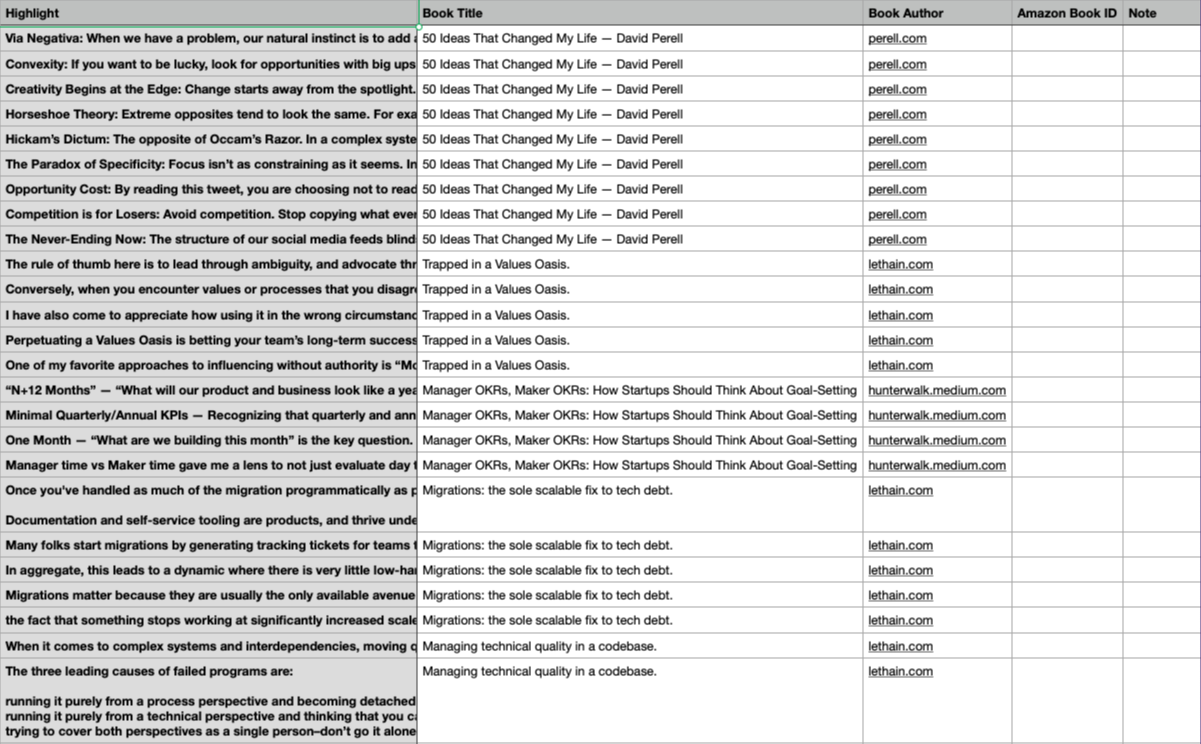
I wanted to tinker with llm and “AI engineer” up a humble tool for working with my notes, writings, highlights, etc. Emphasis on humble: if I could tinker with any one of those datasets quickly and iteratively, I would mark it as a win. (Previously, Scaling down native dev.) Medium story short, I exported some of my reading highlights, loaded it into a database, and wrapped a quick UI around it to navigate my highlights via embeddings rather than keyword search. A few short sessions later, maybe a few hours total, I had something interesting working. 💪🏻
1. Data
For several years, I’ve used Readwise to capture highlights and search/review them later. Handily, Readwise has CSV (and tree-of-Markdown files) exports of all one’s highlights. As data formats go, CSV is nearly perfect for this exercise. It’s structured, so parsing is not required to shoehorn it into a low-ceremony data pipeline. That said, Readwise’s export isn’t perfect: notably it lacks URLs the highlights started with. But for experiments, it’s a start.
2. Pipeline
Thanks to sqlite-utils, I can generate a SQLite database from the export CSV. This all happens by convention with the sqlite-utils command line.
db:
    sqlite-utils insert \
      highlights.db \
      highlights \
      data/readwise-data-2.csv \
      --csv \
      --pk id
No bespoke (Python) code is required in this whole pipeline process. I ended up encapsulating the steps in a Justfile, but anything that can run shell commands would have done the trick.
Step two is to generate embeddings. With the right install, this is another one-liner, this time with llm. We query the database generated in the previous step to give us content to pass through to a text embedding model. The generated vectors are stored into the same SQLite database.
embed:
    llm embed-multi \
      docs \
      --database highlights.db \
      --store \
      --sql 'select id, highlights."Book Title" as title, highlights."Highlight" as content from highlights' \
      --model mpnet
There is no step three! The data is ready to query for “semantic”, not keyword, similarity search. To prove to myself I had an end-to-end working proof of concept, I used this snippet to query the data:
# $ just query "now is not the time for notes"
query q:
    llm similar \
      docs \
      --database highlights.db \
      --content '{{q}}'
3. Prototype
Next, I put it all together in a FastHTML app. This was fun! FastHTML is great for this kind of bespoke, informal hacking. Caveat, some of this may not be idiomatic Python. I’m just coming back to Python after not having written it in seriousness for twenty years.
- Using the
dataclassdecorator on a class and a method for converting an object to a “FastTag”, love this for low-ceremony but typed data modeling. - I finally got the grasp of Python’s generator syntax. I want to like
itertools, but it’s a pain to use. (🌶️ Ruby’sEnumerableremains undefeated.) - JSX-like syntax to structure UI in code is great. This approach falls down every time I put a designer in front of an editor, but I’m going to call it: this is the mark-up/UI-construction ergonomics developers crave.
- There’s no need for a layered web-app approach here. There’s a
similarfunction that turns query text into similar highlight “model” objects. That’s a nice affordance for working quickly and loosely.
Conclusions
Python’s has pleasant things going on lately. Even a career Ruby developer like myself can find kind things to say. 😉
The trickiest part to building with LLMs and generative AI is source data. Prompting a model as-is is not much more interesting than using ChatGPT or Claude. Ergo: look to one’s notes, posts, highlights, etc. to find compelling data to build upon.
Variations on RAG (this is probably a bit short of calling itself RAG, but it’s very close) produce more appealing results than keyword indexing, but not by much. I don’t think it’s the center of a product yet; more of a sidebar or enhancement.
All of this took less than five hours to build. I’ll probably end up spending a couple of hours total writing it up. This is the kind of “working with the garage door up” kind of thing I want to do. 💯📈
Currently reading
- 🐙 Van Pelt, Remarkably Bright Creatures: on an octopus and a widow. A recommendation from my sister. I could go with more octopus narration.
- 🕰️ Burkeman, Four Thousand Weeks: the thesis is that no amount of time management gives you infinite time, so you might as well take advantage of the present.
- 🧐 Arendt / The Human Condition: reading along with Commonplace Philosophy.
- ⏸️ Holiday/Right Thing, Right Now: on morals, through the lens of many historical tales and Stoicism.
- ⏸️ Lichtenberg/The Waste Books: turns out, witty one-liners and reflections on life look about the same in notebooks from the 18th century as they do on modern social media. 😅
Ideas stuck in my head
Is there really a way to push back on the complexity of the web? — Tom MacWright on the plight of modern, full-stack software development.
On loving your fate, how to handle pressure, and the value of being proactive yet positive – James Clear on tackling the challenges of life.
You don’t need Scrum. You just need to do Kanban right. — Lucas F. Costa on how Scrum is a hobbled version of Kanban, if you squint right.
The Trouble with Tools. Daniel Miller on notes, tasks, projects, and the overlapping tension of using software to manage them.
It remains very true that all software expands to the point that it can host checklists. I try not to worry too much when a task list emerges from a note. If I can keep that task list short-lived, i.e., finish it within a working session, it’s not a problem.
I continue to wish Things would do their very well-considered thing and make notes a first-class concept in their app. But only if they can solve it with their consistently high quality of thoughtfulness and execution. Until then, I’m thrilled with them not bolting it on at all.
Lately, I’m choosing my apps for simplicity of general-purpose use. Customization and scriptability are great on paper. But then I fiddle too much instead of getting stuff done.
That said, I have three different notes-shaped apps in my daily workflow. I’m basically fine with this! Maybe I’m done with all-knowing, open-ended, monolithic apps for Managing All the Work. 🤞
Bruce Springsteen’s “No Nukes” concert is one of the better early period surveys of his work. But what I’m really after, lately, is a middle-period summary of his discography. A live album highlighting the material from Born in the USA through The Rising. Two very different peaks in his career, with some of this most unique albums in between.
Backlogs
Can’t live with ‘em, can’t live without ‘em🤷♂️
A product team (at least the ones that have been working for more than three weeks) has a backlog of work they’d love to tackle, but now’s not the right time. Maybe it’s not the most important, a practical solution isn’t in-hand, the technology isn’t ready yet, or a dependency hasn’t started work yet. Either way: a growing, somewhat discouraging list of things they want to do but can’t yet.
Over time, a backlog evolves to many forms. None of them are ideal. We have to look at backlogs for what they are: an artifact of time’s finite-ness and our finite ability to do work in the present.
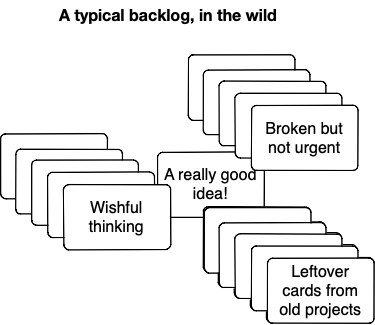
A “big pile of sadness backlog” doesn’t acknowledge limitations in time and capacity. It imagines a future where we can do everything we’ve ever wanted. The backlog actually gets shorter. All those problems we once wanted to solve, we can. We are also a bit taller, more attractive, and feel a bit younger while we’re at it.
But that day never comes, and we’re left with a sad backlog of things. Almost (and this is the nefarious part) all of them less important than what we’re currently doing, but still, we think, important. So it stares at us from the shadows, a bit sad and discouraging us that we are failing at our job by having this large backlog of ideas and promising projects. At least we think they’re promising! More likely, in my experience, attempting to triage the pile of sadness backlog yield two more meta-projects around organizing the sadness to highlight the truly sad from the merely unfortunate. 😮💨
It’s more helpful to look at a backlog as numerous maybe-good ideas sent to our future-selves. By definition, a backlog is speculation. We thought executing on these projects and tasks would improve things, but we won’t know until we do. Schrödinger’s cat and all that. Storing all that speculation away in a pile is healthy. If it turns out one of these ideas is the right starting point for the next most important problem we face, we’ll pull it out of the backlog and give it a think. Otherwise, it stays there, putting no current work at risk.
The contents of a backlog are frozen in time. The tasks, projects, docs, designs, screenshots, diagrams, etc. all reflect a point in time. Some call this rot, implying “hey, we should have been better about keeping this campsite clean and used our (infinite 😜) time to tend it”. IMO that’s not the best approach; better to regard aging tasks as issues and solutions from a point of time. They may no longer reflect the circumstances the product and team currently face. Items in a backlog necessarily need updating by a PM or developer to figure out if they still make sense, would solve the problem, or are a direct solution to that problem.
I have quite the extended personal backlog of items to read and project ideas. When I regard them as missed opportunities, as evidence that I could have been at least a little more diligent in managing my time, it’s stressful and discouraging. When I instead regard it as a pile of ideas in reserve for mornings I wake up and none of my current hobby projects are enticing or what I’m reading isn’t doing it for me, then those backlogs are useful. Granted, said lists aren’t getting much shorter.
Perhaps, a backlog is a defense mechanism. They are, at times, a way to deliver a soft no, to ourselves or collaborators. “Not a bad idea, but not something we can get to right away. It’s in the backlog. Maybe someday we’ll come upon it.”
Or, you may have an impeccable backlog! All killer, no filler; like a “no-skips” album, but in product backlog form. If you’re out there, please let us know how you got here and how much effort it takes. 😆 (Really, if you’re out there, I’m intrigued!)
The flip side is no backlog at all. The project work is a river and if something interesting floats past, you seize upon it. Otherwise, you let it float downstream and don’t worry about it too much. Or, there’s no team backlog, but the team members keep a list of ideas/task/projects that might be interesting in the future and bring them up at opportune moments. That works too!